Prologue: Dinosaurs and Stones

170 million years ago – 6th c. BC

Dinosaur footprints and Côa rock art

Long before people, Portugal was the shore of a young Atlantic Ocean. It was only just beginning to open, and the same dinosaurs that lived in North America walked these lagoons: the continents still nearly touched. Their footprints survive on cliffs above the sea and in old quarries, and eggs with embryos turned up in a cliff near Lourinhã. Then people arrived and began carving horses and aurochs into the rocks. Much later, the country saved those carvings from being drowned.

Each story reveals part of the panel

Panel of the era: 54 of 54 tiles open

Timeline of this era

Hidden stories: 1.

  1. 170 million years ago
    readNew
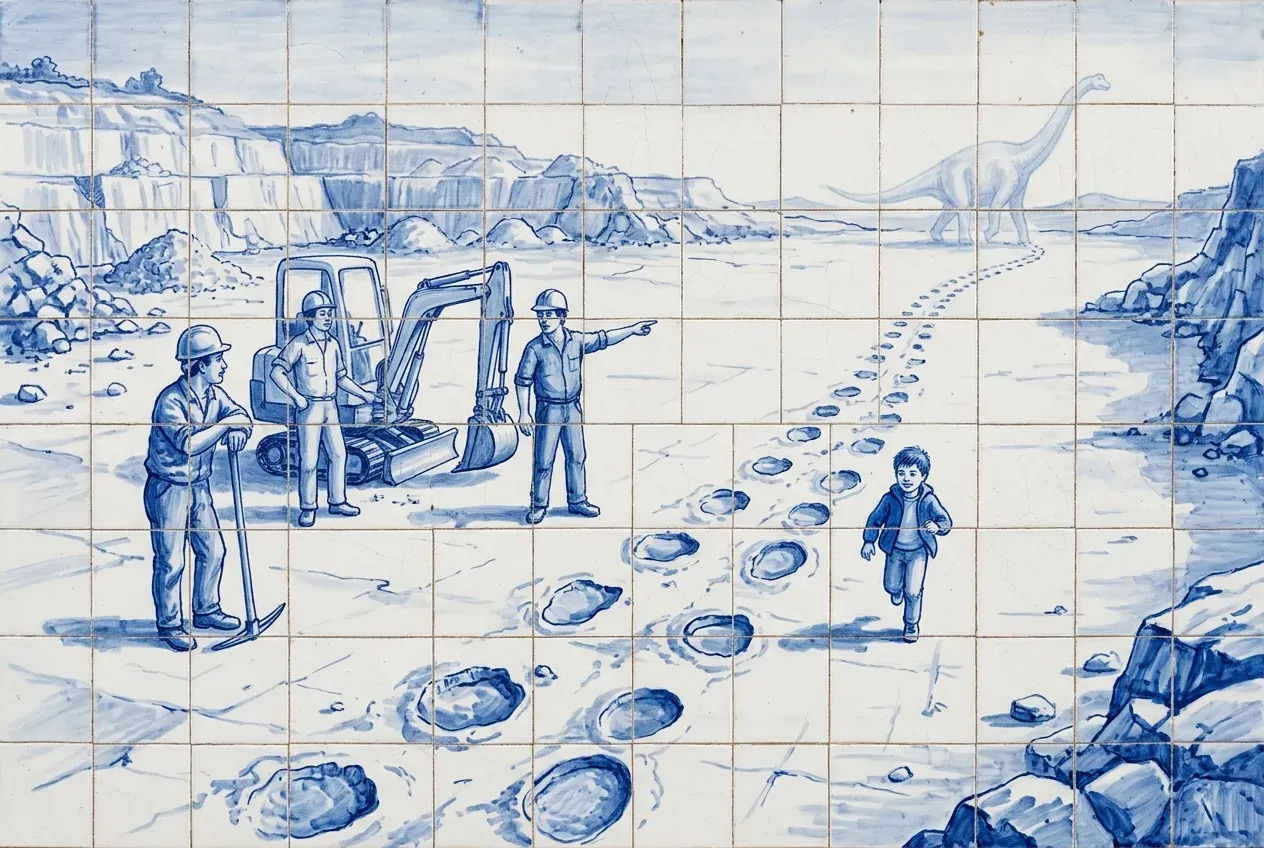
    Blue-and-white azulejo-style illustration: in a quarry, three workers in hard hats, one with a pickaxe and one pointing, stand beside a mini-excavator; two lines of huge footprints cross the slab, a boy runs alongside them, and a long-necked dinosaur stands far away.

    about 170 million years ago · Serra de Aire

    A 147-Meter Stroll

    Footprints 170 million years old shut down a limestone quarry. (Read the story)

    For years, the Galinha family quarried limestone in the Serra de Aire, near the village of Bairro outside Ourém. The stone came off layer by layer, and in the summer of 1994 rows of huge dents appeared on a freshly exposed slab. They were sauropod footprints. About 170 million years ago this was shallow water, and long-necked giants walked across the soft mud. The mud turned to stone, new layers covered it, and the footprints stayed hidden until the quarry workers uncovered them. The longest trackway runs for 147 meters, one of the longest known in the world. Quarrying any further would have destroyed the find. So the quarry was closed, and the slab was declared a natural monument.

    More →
  2. 152 million years ago
    readNew
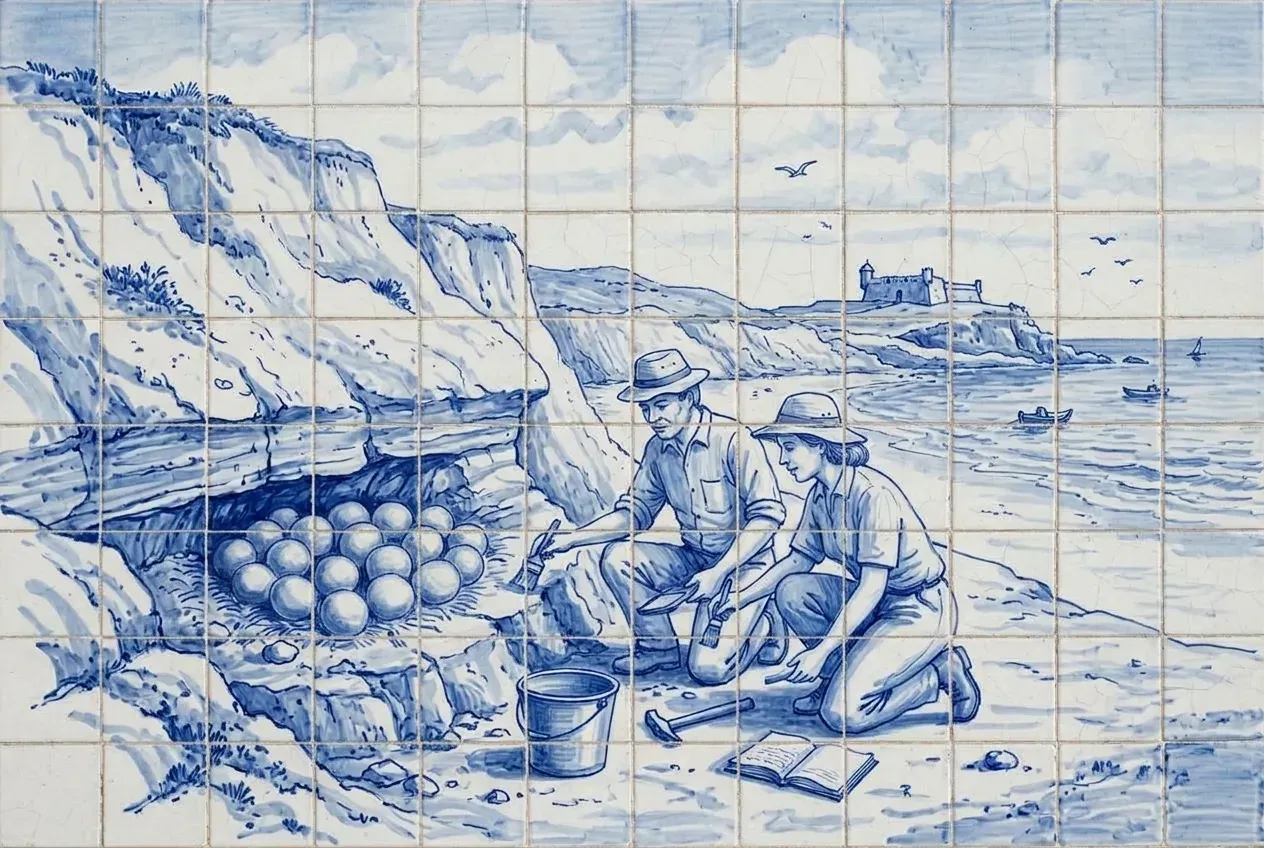
    Blue-and-white azulejo-style illustration: a man and a woman in hats kneel on a beach and brush a nest of about twenty eggs out of a cliff; beside them a bucket, a hammer and a notebook, and a fort on a headland in the distance.

    about 152 million years ago · Lourinhã

    The Nest the Flood Took

    A flood destroyed a dinosaur nest and saved it for us. (Read the story)

    In 1984, Isabel and Horácio Mateus and a group of friends founded a small museum in Lourinhã and began collecting fossils along the local coast. They kept searching, and in 1993, in a cliff above Paimogo beach, they spotted bits of eggshell in the rock. There was a lot of shell because it was a whole nest: about a hundred eggs of a meat-eating dinosaur, most likely Lourinhanosaurus. And inside some of the eggs were the tiny bones of babies that never hatched. Dinosaur eggs turn up fairly often, but embryos inside them almost never do: their fragile bones rarely survive. So paleontologists around the world heard about the little museum, and Lourinhã came to be called Portugal’s dinosaur capital.

    More →
  3. 150 million years ago
    readNew
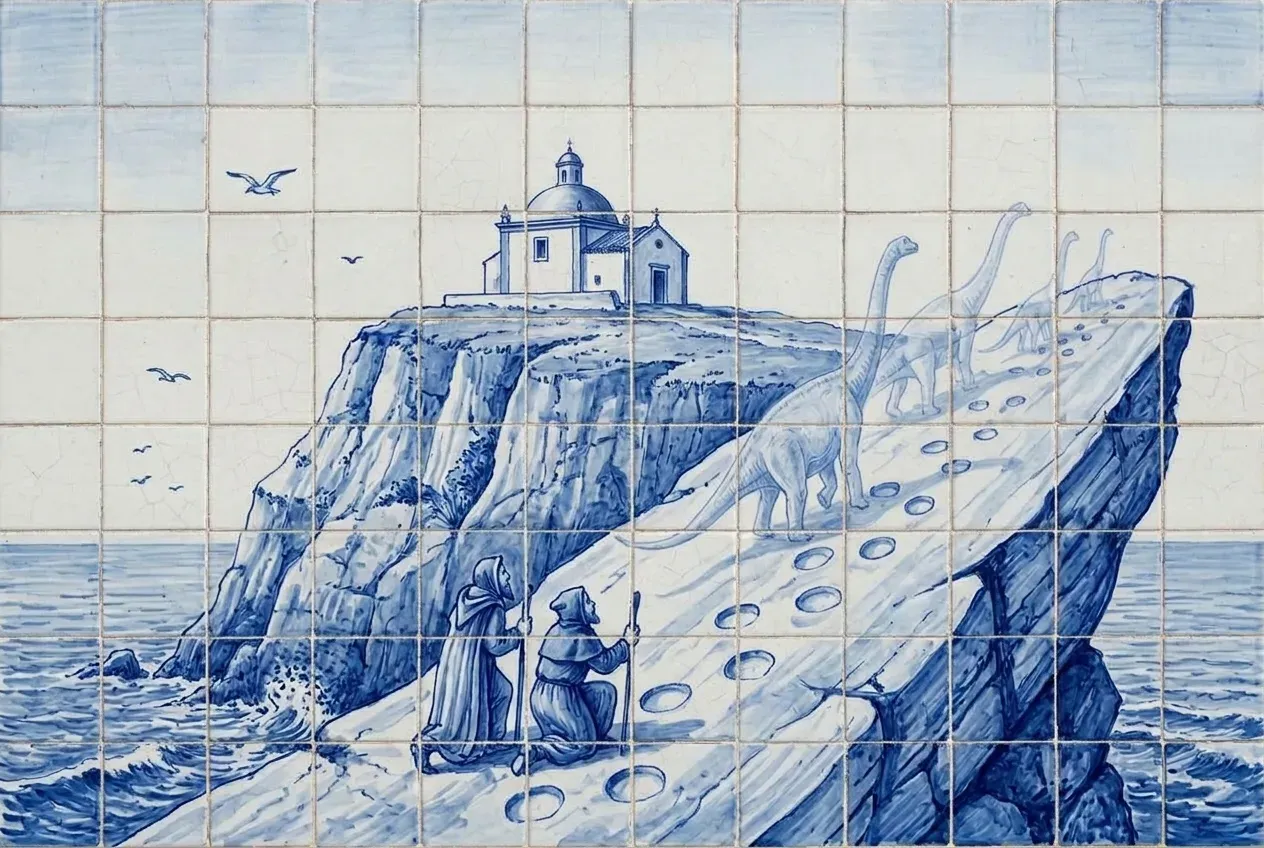
    Blue-and-white azulejo-style illustration: two hooded pilgrims kneel before a tilted slab full of round hollows, along which almost transparent long-necked dinosaurs walk; on the clifftop above the sea stands a domed chapel.

    about 150 million years ago · Cape Espichel

    The Miracle the Dinosaurs Left Behind

    Pilgrims visited a mule’s footprints for centuries. The mule was a dinosaur. (Read the story)

    At Cape Espichel, south of Lisbon, people have long told of a miracle. The Virgin Mary is said to have risen from the sea and climbed the cliff on a mule, its hooves leaving marks in the solid rock. Anyone who walked to the edge could see the prints, so people believed. For centuries pilgrims came to the cape: a chapel went up on the cliff, and later a large sanctuary grew beside it. The rows of round hollows really are there, on a tilted slab above the sea. But in the 1990s scientists found that the mule had nothing to do with them. About 150 million years ago, sauropods, huge long-necked plant-eating dinosaurs, walked across a muddy shore. The miracle that drew the pilgrims turned out to be dinosaur footprints.

    More →
  4. 150 million years ago
    readNew
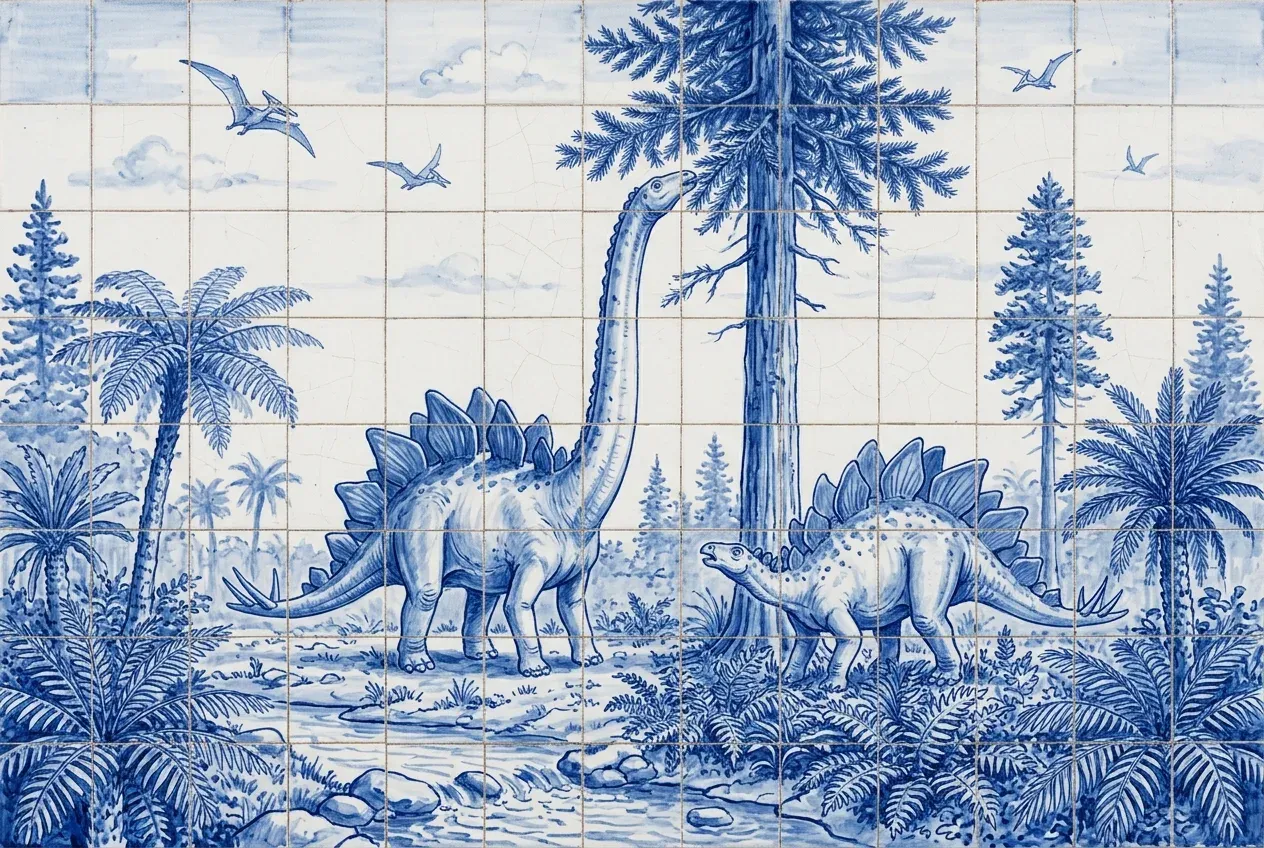
    Blue-and-white azulejo-style illustration: two stegosaurs among ferns, palms and conifers, one with a very long neck stretched toward the treetops, and pterosaurs in the sky.

    about 150 million years ago · Miragaia

    The Long-Necked One from Miragaia

    The Portuguese stegosaur that wanted to be a giraffe. (Read the story)

    You can spot a stegosaur at a glance: plates down the back, spikes on the tail, a short neck near the ground. In 1999, near the village of Miragaia outside Lourinhã, road builders uncovered bones that didn’t fit that picture. Paleontologists dug them out in 1999 and 2001 and recovered almost the entire neck. It had at least 17 vertebrae, more than most sauropods, the famous long-necked giants. Science knew of no stegosaur with a neck like that, so in 2009 the find was described as a new species and named Miragaia longicollum, “the long-necked one from Miragaia.”

    More →
  5. ⋯ nearly 150 million years pass ⋯
  6. 28,000 years ago
    readNew
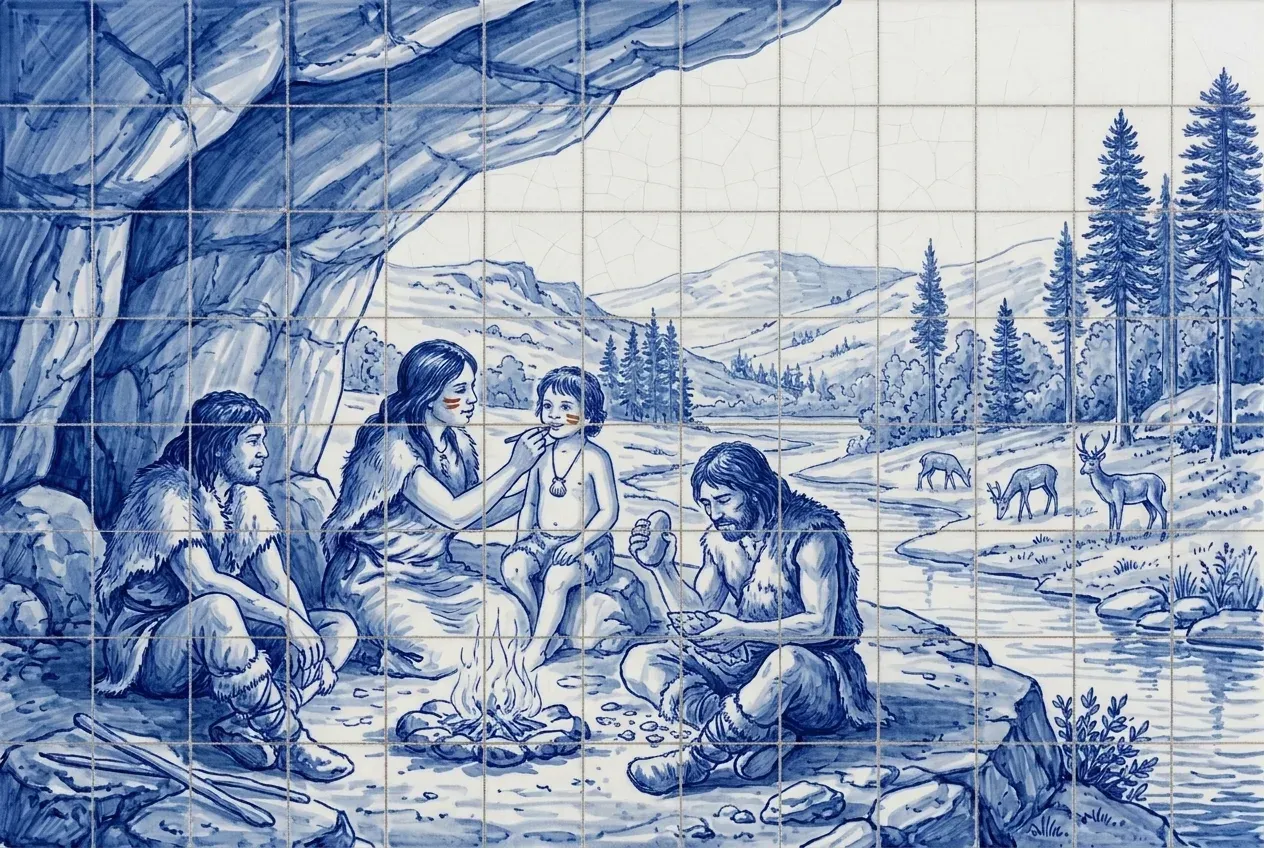
    Blue-and-white azulejo-style illustration: under a rock shelter a family sits by a fire; the woman paints stripes of red ocher on the face of a child wearing a shell on a cord; in the background deer by a river and pine trees.

    about 28,000 years ago · Lapedo Valley

    The Child Scientists Still Argue About

    • Debated
    • People like us
    • Minimum age: 12+ (Has scenes of battle or violence.)
    • Heavy topic
    A four-year-old from Leiria had scientists arguing for twenty years. (Read the story)

    In late November 1998, archaeologists went to see the rock paintings at Lagar Velho, a rock shelter in the Lapedo Valley near Leiria. Shortly before, machinery had churned up the ground there, and bones had surfaced in it. It was the grave of a child about four years old, buried about 28,000 years ago with care: with a seashell and red ocher. But something else surprised the scientists. In almost every way it was a child of our own species, but its legs, sturdy and differently proportioned, were like a Neanderthal’s. Archaeologist João Zilhão and his colleagues proposed that the two human species had met and had children together, and that their descendants carried traits of both for a long time. That idea was argued over for years, and the debate still isn’t over.

    More →
  7. over 20,000 years ago
    readNew
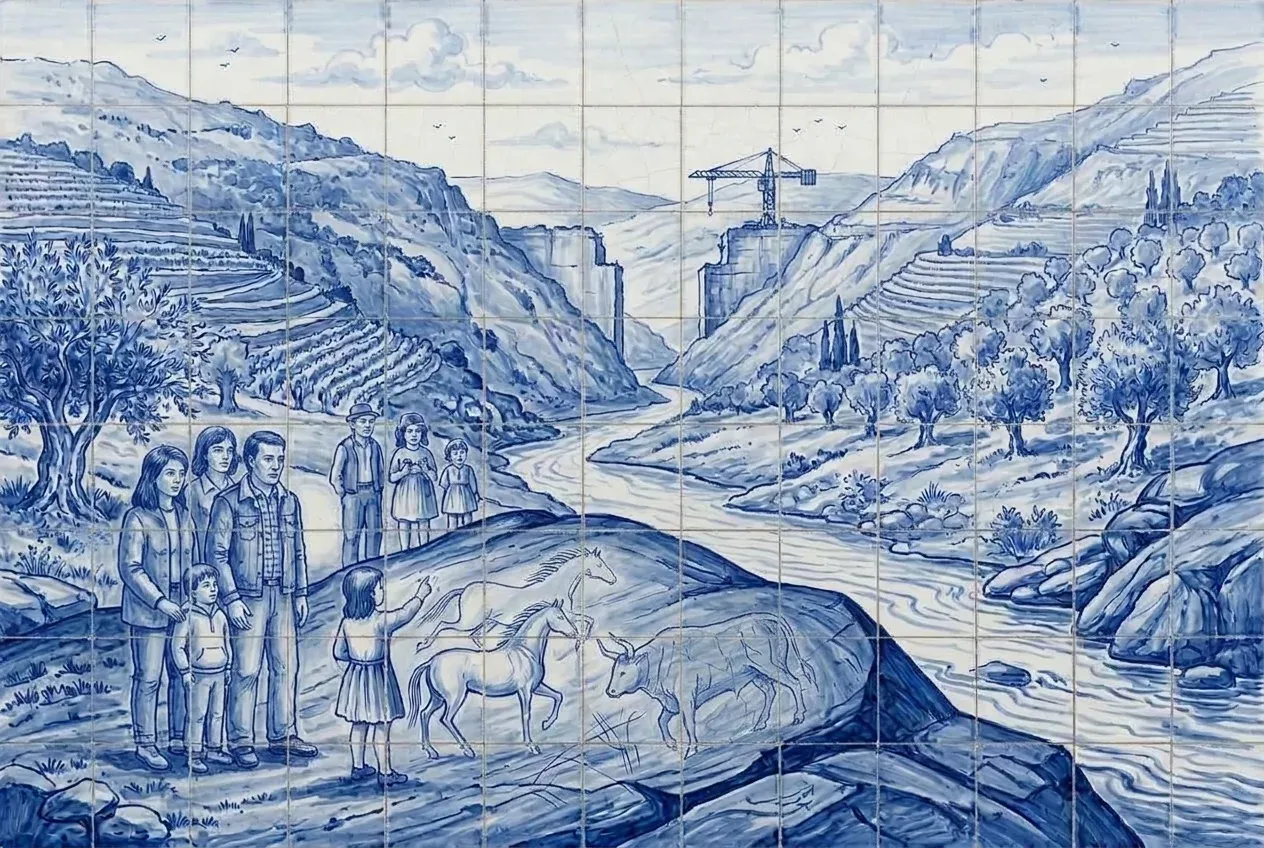
    Blue-and-white azulejo-style illustration: a family and a girl who points stand before a rock with engraved horses and an aurochs, above a river between terraced slopes; far away a crane builds the wall of a dam.

    over 20,000 years ago · Côa Valley

    The Engravings That Can’t Swim

    A dam was scrapped over Stone Age rock art. (Read the story)

    In the early 1990s, work began on a dam on the Côa River in northeastern Portugal. Its reservoir was going to flood the valley. While construction went on, archaeologists noticed figures carved into the schist rocks by the river: horses with manes, aurochs, deer, and wild goats. The oldest are more than 20,000 years old. If the dam had been finished, they would have been underwater forever. In 1994 the newspapers reported the find, and locals, scientists, and journalists across the country rallied to save the engravings. Their slogan became “The engravings can’t swim.” In November 1995 the new prime minister, António Guterres, canceled the project, and instead of a reservoir the valley got an archaeological park.

    More →