
The Long-Necked One from Miragaia
The Portuguese stegosaur that wanted to be a giraffe.
The story
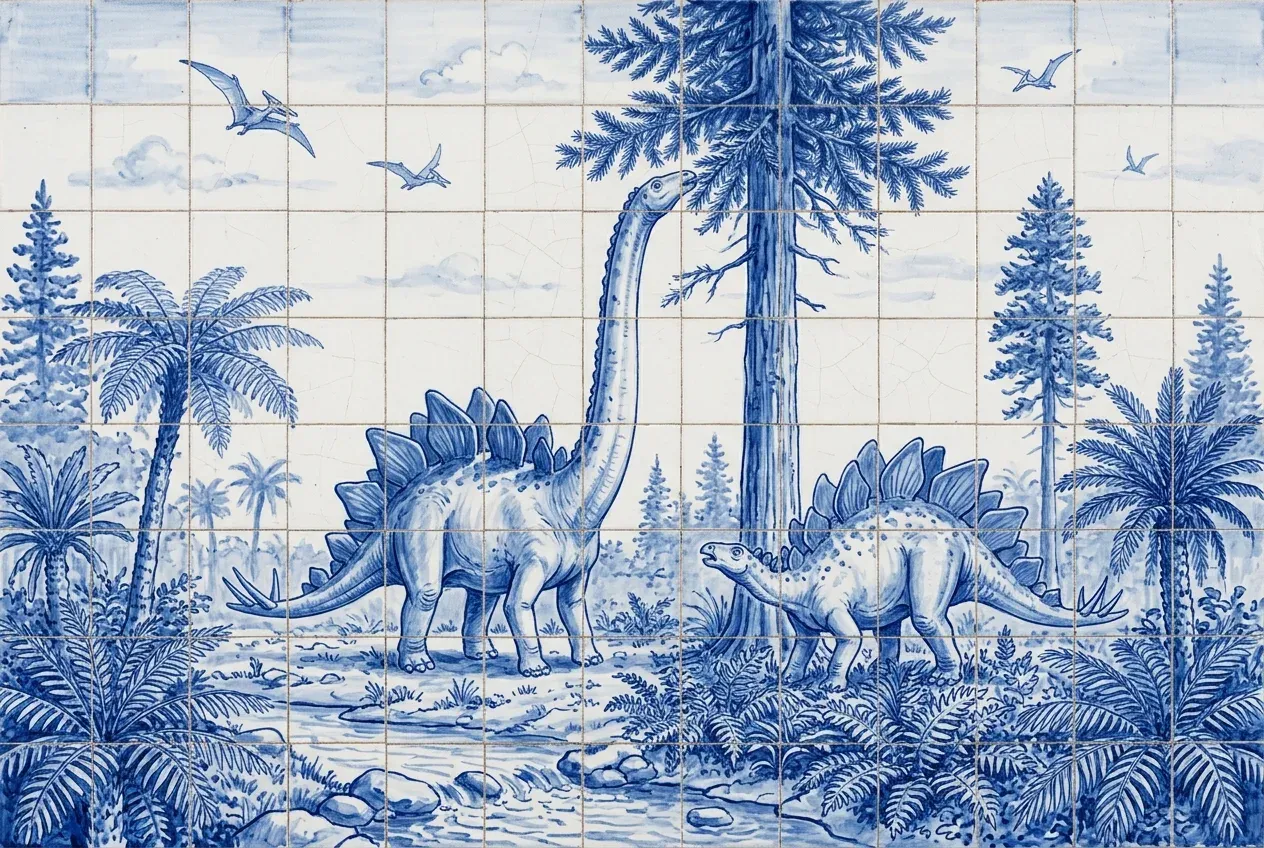
You can spot a stegosaur at a glance: plates down the back, spikes on the tail, a short neck near the ground. In 1999, near the village of Miragaia outside Lourinhã, road builders uncovered bones that didn’t fit that picture.
Paleontologists dug them out in 1999 and 2001 and recovered almost the entire neck. It had at least 17 vertebrae, more than most sauropods, the famous long-necked giants. Science knew of no stegosaur with a neck like that, so in 2009 the find was described as a new species and named Miragaia longicollum, “the long-necked one from Miragaia.”
Meanwhile
- about 150 million years agoIts relative Stegosaurus lived in North America.
More
Context
The neck survived almost whole: 15 vertebrae were found, with only the first two missing. No other stegosaur had such a long neck.
No one knows for sure what it was for. The authors of the description offered two explanations. Perhaps it let Miragaia reach leaves higher up than its neighbors could, so it competed less for food. Or the long neck helped it attract mates, like a peacock’s tail.
The debate over Miragaia isn’t settled. Some scientists think it isn’t a genus of its own but another species of Dacentrurus, a stegosaur whose bones also turn up in Portugal. Others argued again in 2025 that Miragaia stands on its own. The bones it was described from are kept at the Lourinhã Museum.
Where to see it today
Lourinhã Museum
Museu da Lourinhã
This is where the bones Miragaia was described from are kept.


Sources (2)· links checked on
- Mateus, Maidment, Christiansen, 2009, Proceedings of the Royal Society B: description of Miragaia longicollum
- Wikipedia: Miragaia (dinosaur) · Digs of 1999 and 2001, the dispute over the genus
That was the last story of the era “Prologue: Dinosaurs and Stones.” Your panel is complete →