The Miracle the Dinosaurs Left Behind
Pilgrims visited a mule’s footprints for centuries. The mule was a dinosaur.
The story
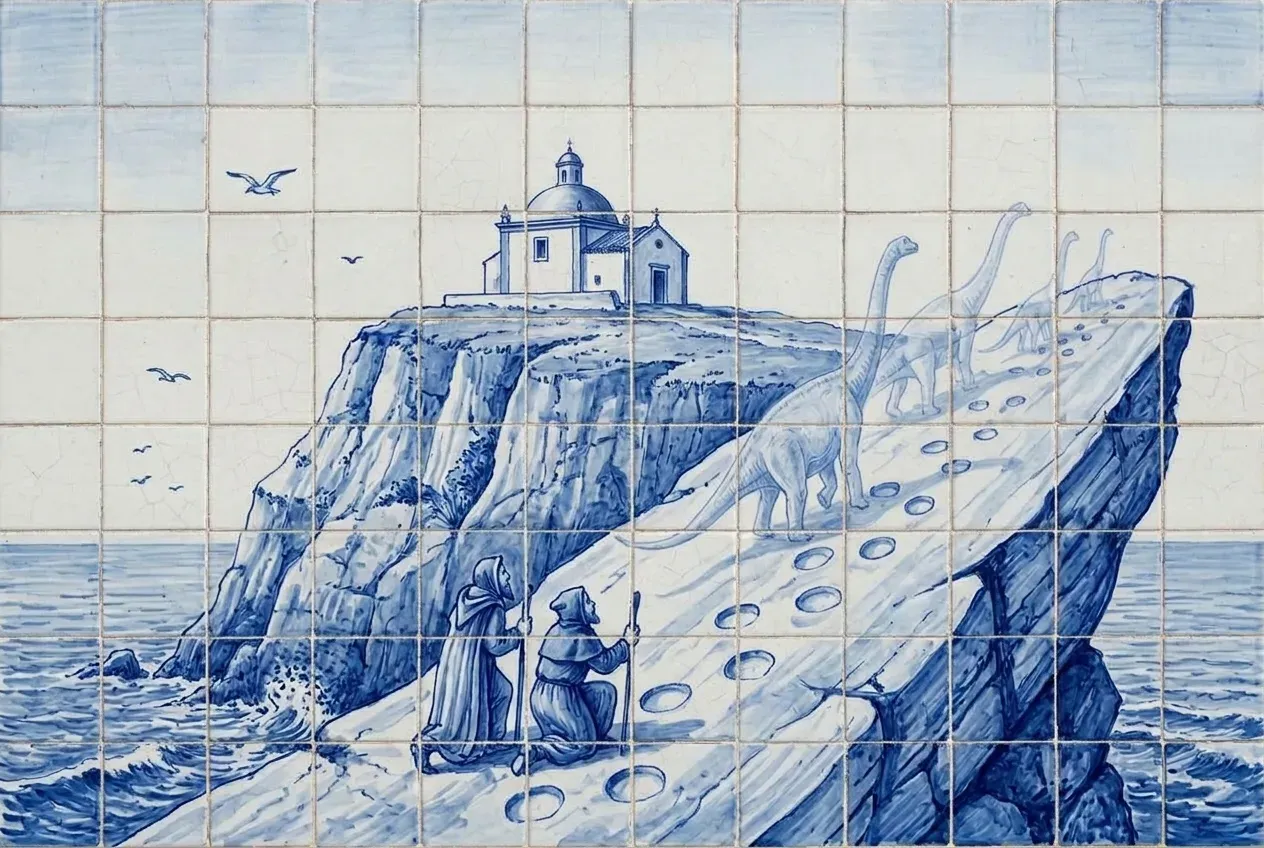
At Cape Espichel, south of Lisbon, people have long told of a miracle. The Virgin Mary is said to have risen from the sea and climbed the cliff on a mule, its hooves leaving marks in the solid rock.
Anyone who walked to the edge could see the prints, so people believed. For centuries pilgrims came to the cape: a chapel went up on the cliff, and later a large sanctuary grew beside it.
The rows of round hollows really are there, on a tilted slab above the sea. But in the 1990s scientists found that the mule had nothing to do with them. About 150 million years ago, sauropods, huge long-necked plant-eating dinosaurs, walked across a muddy shore. The miracle that drew the pilgrims turned out to be dinosaur footprints.
Meanwhile
- about 150 million years agoArchaeopteryx, one of the first birds, lived in what is now Germany.
More
Context
The slab is even called Pedra da Mua, “the mule’s stone.” It was once a flat, muddy shore, but over time the rock layers rose and tilted. That’s why the footprints now sit on a slope, and it looks as if the animal walked straight up the cliff, just as the legend says.
Scientists read more in these footprints than “dinosaurs were here.” The slab holds several trackways, and nearly all were left by small, probably young animals walking side by side in the same direction. It is one of the first signs found in Europe that sauropods moved in herds.
The legend lives on all the same. Inside the Ermida da Memória, the tiles still show the Virgin and Child riding the mule. It is a rare place where a miracle and a scientific explanation point to the same footprints.
Where to see it today
Ermida da Memória chapel, Cabo Espichel
Ermida da Memória
From the cliff beside the chapel you can see the slab the “mule” climbed.


Sources (2)· links checked on
- Wikipedia: Cape Espichel · The legend, the sauropod group
- Anthony Martin, «Of Sacred Mules and Sauropod Tracks» (Georgia Life Traces) · Retells Lockley, Meyer and Santos (1994); the chapel tiles
That was the last story of the era “Prologue: Dinosaurs and Stones.” Your panel is complete →