A 147-Meter Stroll
Footprints 170 million years old shut down a limestone quarry.
The story
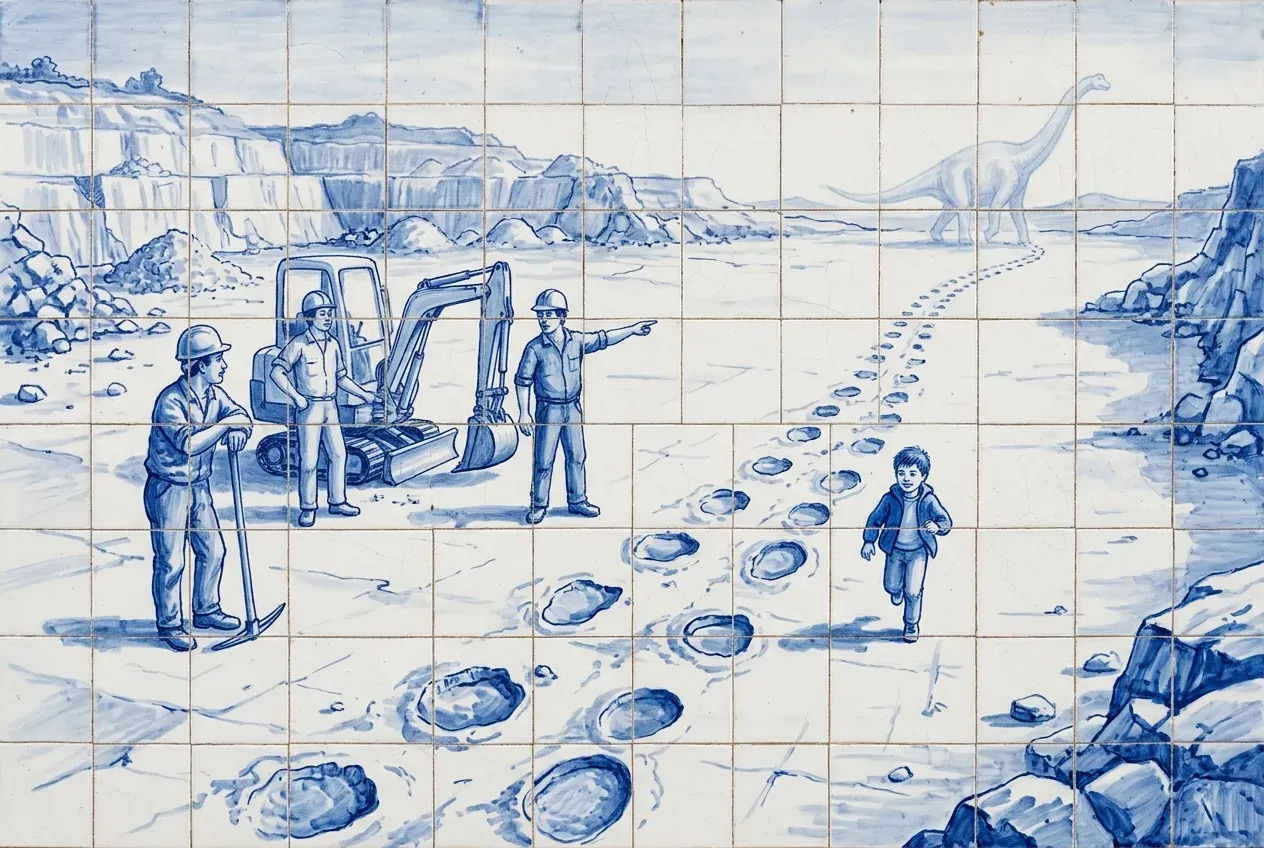
For years, the Galinha family quarried limestone in the Serra de Aire, near the village of Bairro outside Ourém. The stone came off layer by layer, and in the summer of 1994 rows of huge dents appeared on a freshly exposed slab.
They were sauropod footprints. About 170 million years ago this was shallow water, and long-necked giants walked across the soft mud. The mud turned to stone, new layers covered it, and the footprints stayed hidden until the quarry workers uncovered them. The longest trackway runs for 147 meters, one of the longest known in the world.
Quarrying any further would have destroyed the find. So the quarry was closed, and the slab was declared a natural monument.
More
Context
Sauropods left two kinds of prints. The hind feet made large oval pits, the front feet smaller horseshoe-shaped ones. From the spacing, scientists can tell how big the animal was, how long its stride was, and where it turned.
Sauropod footprints this old, from the Middle Jurassic, are rare worldwide. That’s why paleontologists far beyond Portugal know the Galinha quarry: it shows how the long-necked giants walked long before the predators in the neighboring story laid their eggs at Lourinhã.
Today a path runs across the slab, and you can walk alongside the longest trackway, step by step.
Where to see it today
Natural Monument of the Dinosaur Footprints of the Serra de Aire
Monumento Natural das Pegadas de Dinossáurios da Serra de Aire
The path follows the longest line of footprints.


Sources (3)· links checked on
- Atlas Obscura: Pedreira do Galinha · 1994, 147 m
- DGEG, Roteiro das Minas: Natural Monument of Dinosaur Footprints of the Aire Sierra · 147 m and 142 m, “among the longest known in the world”
- Wikipedia: Aire Range Dinosaur Tracks Natural Monument · Middle Jurassic, Bajocian–Bathonian (about 170 million years); the page says 175
That was the last story of the era “Prologue: Dinosaurs and Stones.” Your panel is complete →