How Galicians Kept Lisbon Watered
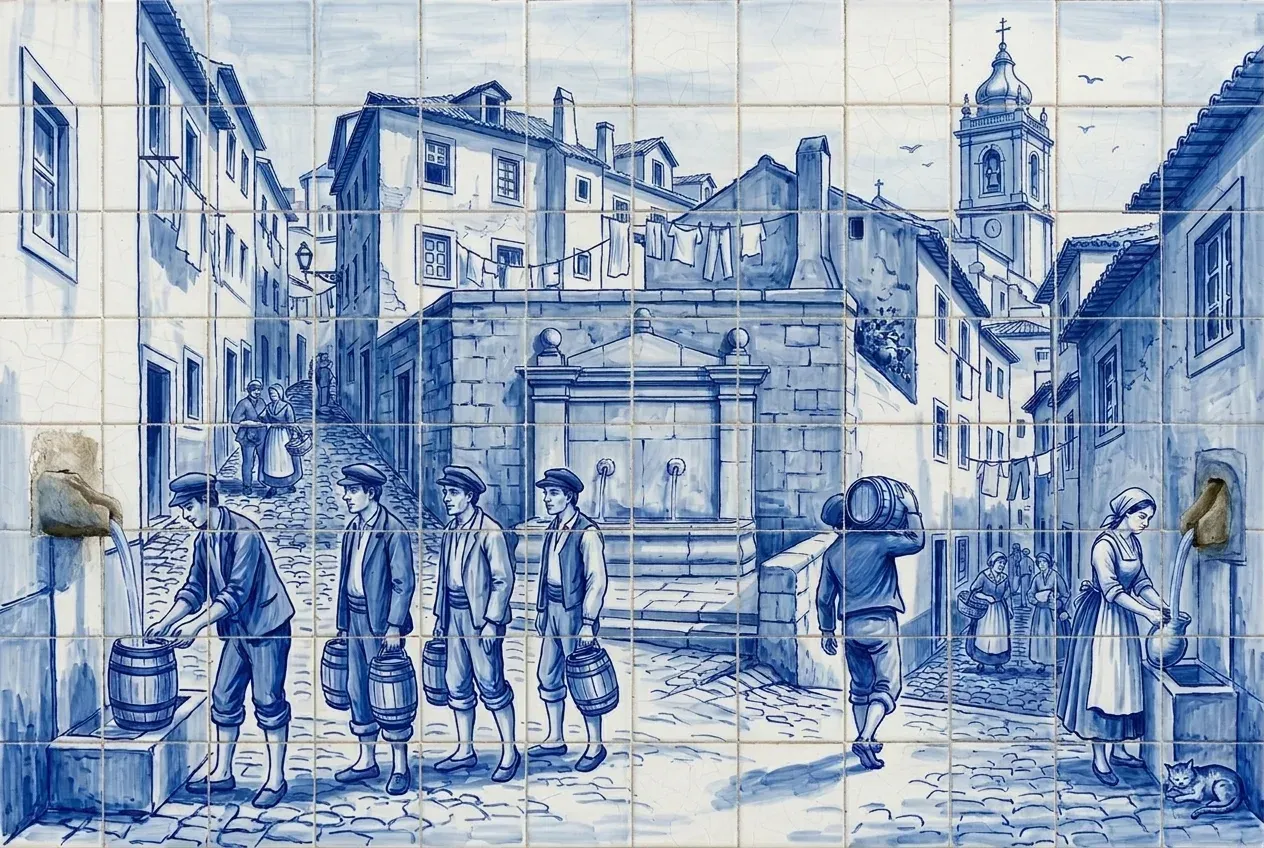
Galicians with barrels on their shoulders kept Lisbon watered for centuries.
The story
Until the late 19th century, Lisbon homes had no running water. People fetched it from the city’s public fountains and then hauled it up the steep streets. Wealthy households paid water carriers to do it.
The carriers were almost always Galicians, from northern Spain around Pontevedra and Vigo. With a barrel on the shoulder and a peaked cap, they went from fountain to customers’ doors. To work, you had to register with the city council, and breaking the rules meant a fine.
The fountains were always crowded, so to prevent fights the spouts were split between groups: some only for water carriers, some for servants, some for sailors. Piped water reached homes little by little, and the trade disappeared with it.
Meanwhile
- 1748Excavations begin at Pompeii, buried under the ash of Vesuvius.
More
Context
Water carriers also had a duty to the city: keep their barrels ready in case of fire. In a city of wood and narrow streets, that mattered.
Lisbon’s oldest public fountain, the Chafariz d’El-Rei in Alfama, still stands. It once had six spouts, and the city senate decided who each one was for: one for the men from the boats, others for male and female servants, others for men and women of different stations. Three spouts remain today, and no water runs from them.
When piped water pushed them out, many former water carriers reportedly took to selling capilé, a sweet drink.
Where to see it today
Chafariz d’El-Rei
Lisbon’s oldest public fountain; of the six spouts once shared out among its people, three remain.