
The Lisbon Earthquake
Heavy topic. This story deals with a heavy topic.
This story is for teenagers 12+. This story deals with a difficult topic. Open?This story deals with a difficult topic. Open?
The king left Lisbon that morning because his daughter asked.
The story
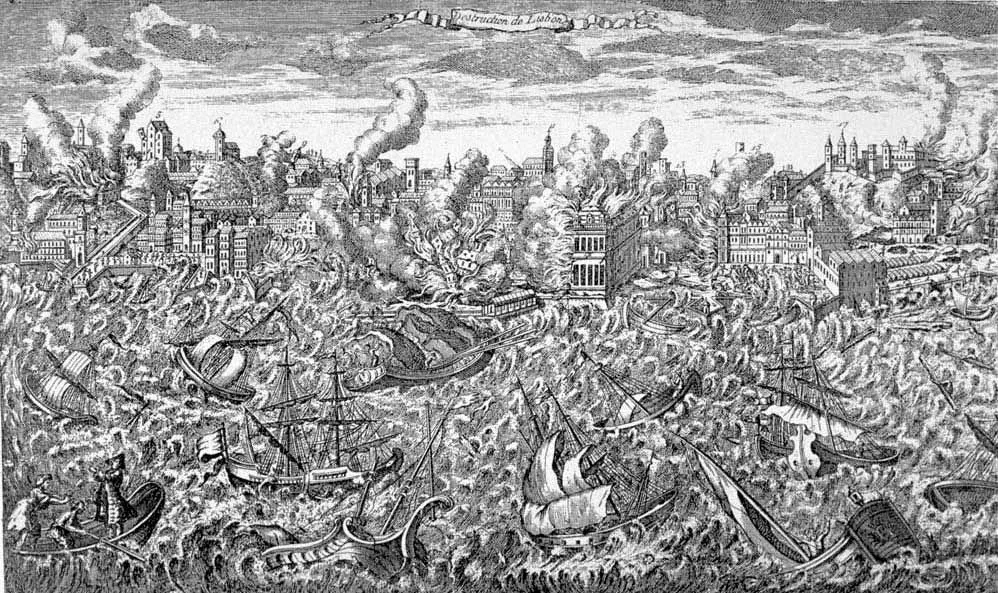
On 1 November 1755, All Saints' Day, King José I heard Mass at sunrise and left Lisbon, because a daughter wanted to spend the holiday outside the city. At 9:40 the earthquake hit; the churches were full. A tsunami and days of fire followed; tens of thousands died. The king lived, but afterwards feared living within walls, and the court moved into tents on the hills of Ajuda.
More
Context
Numbers are uncertain. Economic historian Álvaro Pereira estimates 30,000–40,000 deaths in Lisbon and 40,000–50,000 across Portugal, Spain and Morocco; other estimates range from 10,000 to 100,000. Wave heights are disputed too: a study of primary documents says long-repeated figures, such as 14–16 m at Tangier, should be abandoned. Pombal, the king's chief minister, reportedly said: bury the dead and heal the living. Records show he ordered the bodies removed the very next day, to prevent plague. The king wrote to his brother-in-law in Spain that he had no house, no servants, no subjects, no money, no bread. Today the roofless nave of the Carmo convent, founded by Nuno Álvares Pereira of Aljubarrota fame, serves as the memorial.

Bridge to today
Carmo Archaeological Museum
Museu Arqueológico do Carmo (ruínas do Convento do Carmo)
In Lisbon, the ruins of the Carmo Convent have stood open to the sky since 1755.
Largo do Carmo, 1200-092 LisboaBridge to today: Carmo Archaeological Museum


Sources (6)· links checked on
- The Atlantic Tsunami on November 1st, 1755: World Range and Amplitude According to Primary Documentary Sources (InTech)Accessed on
- Museu Arqueológico do Carmo, folheto (EN): história do edifício e do terramotoAccessed on
- Álvaro S. Pereira, «The Opportunity of a Disaster: The Economic Impact of the 1755 Lisbon Earthquake», The Journal of Economic History 69(2), 2009, pp. 466–499Accessed on
- Harvard ReVista (DRCLAS): «Bury the dead and feed the living»
- The New Criterion: Lisbon's narrow fate
- Junia Furtado, review of Mark C. Molesky, «This Gulf of Fire: The Destruction of Lisbon, or Apocalypse in the Age of Science and Reason» (New York, 2015), e-Journal of Portuguese History, vol. 15, no. 2, 2017 (Dialnet)