
The Queen with a Mustache
Thirteen years after the fall of the monarchy, republicans crowned a king.
The story
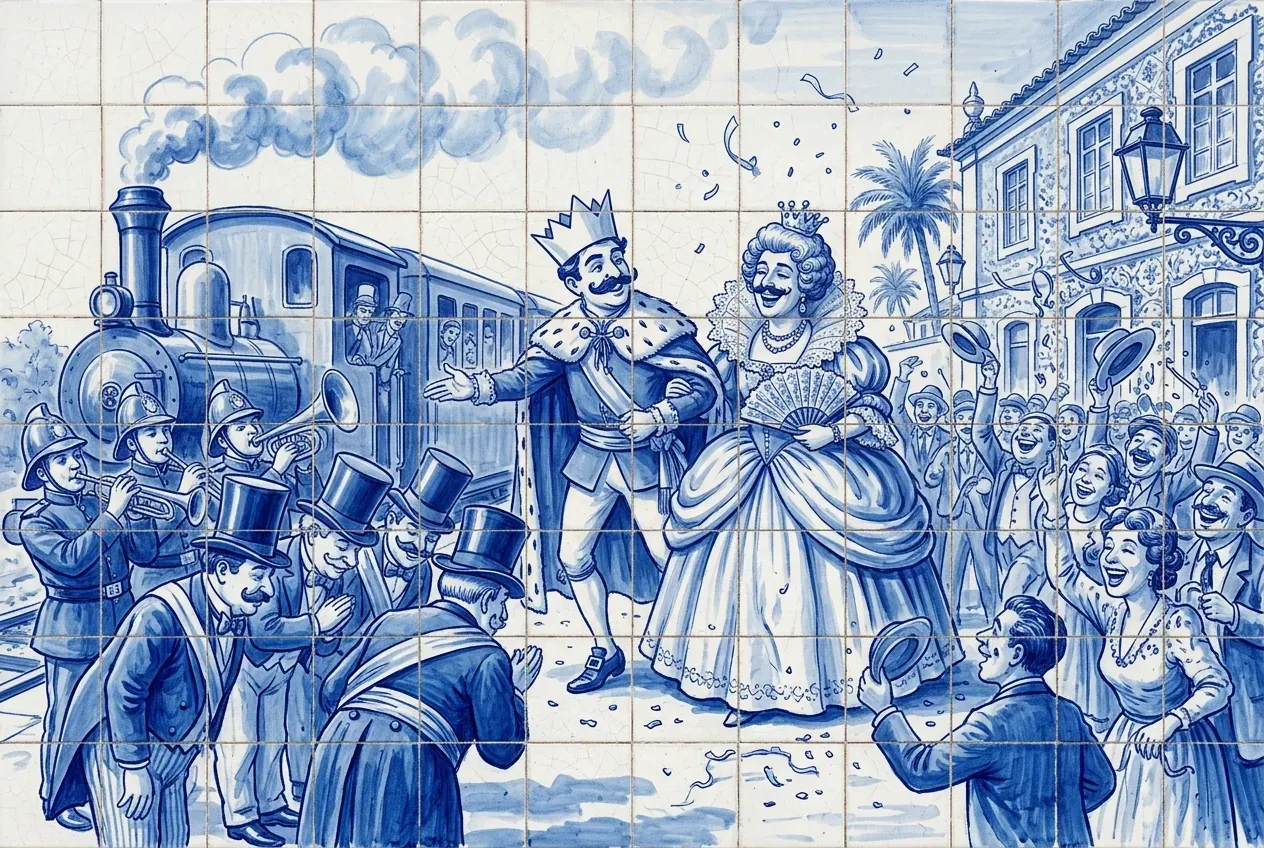
In 1910, Portugal overthrew its king and became a republic. In 1923, republicans and shopkeepers in Torres Vedras, a town north of Lisbon, threw a big street party at Carnival and seated a king on a throne. The next year the king got a queen. A man played her, and behind the couple came a retinue of “ministers” and “matrafonas,” men in women’s dresses. Ever since, by tradition, the queen of the Torres Vedras Carnival has always been played by a man.
More
Context
People here knew how to laugh at power well before that. In 1912, when supporters of the king tried to bring the monarchy back, local republicans staged their “invasion” at Carnival. And the Carnival king, like a real one, arrived by train: “ministers,” matrafonas and a firemen’s band met him at the station. It may be a parody of the visit of Manuel II, the last king, who came to Torres Vedras by rail in 1908.
The Carnival king reigns for four days, and the whole festival is power turned upside down: the king reads a satirical speech and the mayor hands him the keys to the town. The titles of the royal couple are new every year.
In 1999 a monument to Carnival was put up in the town center, and in 2022 the Torres Vedras Carnival was added to the national list of intangible cultural heritage.
Where to see it today
Carnival Monument
Monumento ao Carnaval
The monument the town built for its great festival in 1999.


That was the last story of the era “Monarchy and Republic.” Your panel is complete →