
The Wooden Skeleton of the Baixa
Every building in Lisbon’s Baixa hides a wooden skeleton inside its walls.
The story
The 1755 earthquake brought down the stone buildings of downtown Lisbon. Pombal decided to rebuild the Lisbon’s “lower town” by the Tagus. After the 1755 earthquake it was rebuilt from scratch on a straight grid of streets.All words → from scratch, and to do it so the buildings would survive the next quake.
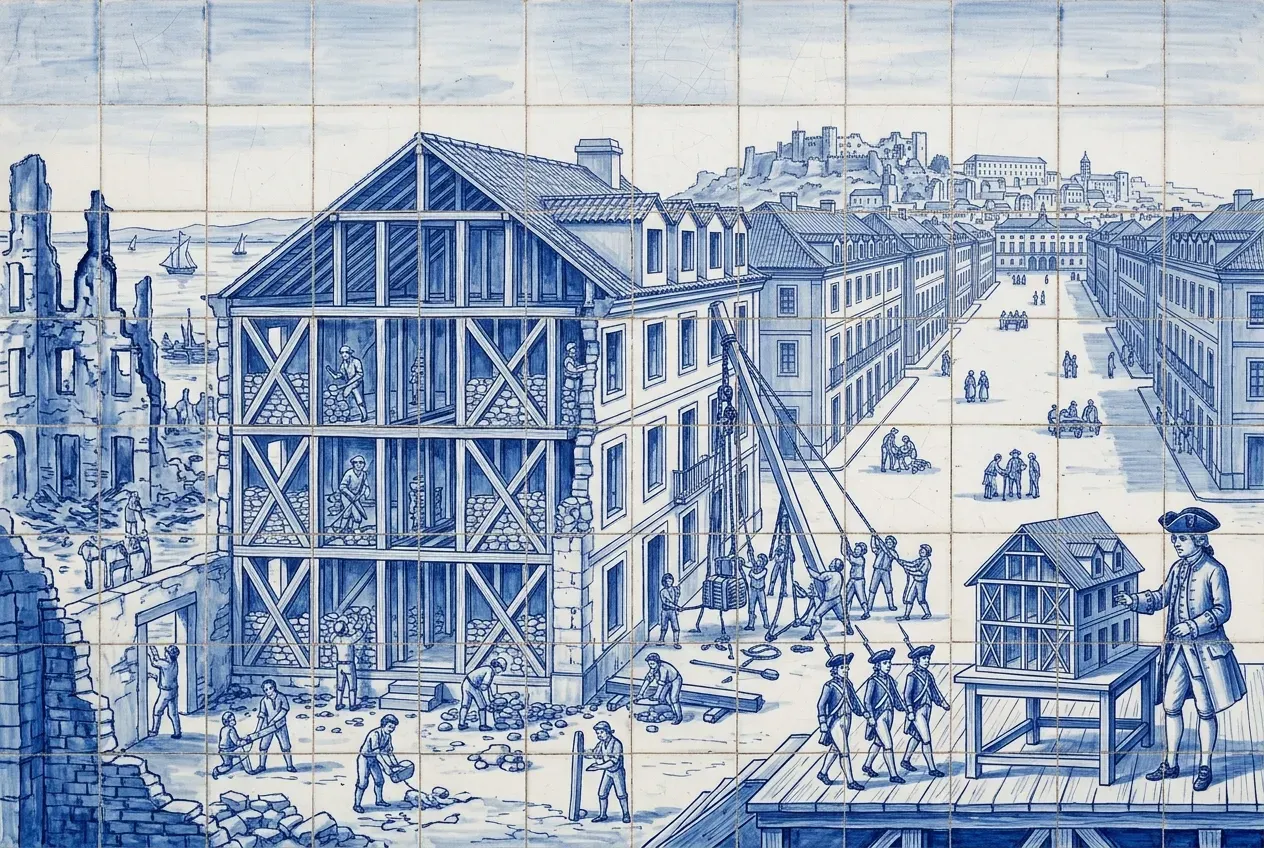
Engineers came up with the gaiola, the “cage.” Inside the walls they set a frame of wooden beams braced in an X pattern. In a quake, stone cracks and falls, but wood bends, holds up the floors, and keeps the walls from falling apart.
The story goes that the frame was tested by soldiers marching next to a model and stamping their feet to imitate the shaking. There are no records of this, and it was most likely a demonstration, not a test.
Meanwhile
- 1759The British Museum opens to the public in London.
More
Context
To get the city up quickly, it was built like a construction kit. Building parts were made outside the city, brought in, and assembled on site. Streets were laid out with a ruler, all the same width, and buildings were limited to four stories.
It was one of the first times in Europe that a city was built with earthquakes in mind. Similar frames were later used in Calabria, in southern Italy, after its 1783 earthquake.
Only in our time could anyone check whether the cage really works. Engineers at Portugal’s National Civil Engineering Laboratory (LNEC) built full-size gaiola walls on a shake table and shook them with rising intensity. Metal plates at the frame’s joints were tested separately, comparing reinforced walls with ordinary ones. Tests like these show how to reinforce the old Baixa buildings, which are still standing.
Where to see it today
Civil Engineering Museum, Técnico Lisboa
Museu de Engenharia Civil, Instituto Superior Técnico
The museum holds the best-known model of the Pombaline cage.


That was the last story of the era “Pombal and the Earthquake.” Your panel is complete →
Test yourself: myth or fact? →
New stories, once a month
One email a month, no ads. Unsubscribe in one click.
Almost done: check your inbox and confirm your subscription.