The Fish Sauce Under the Bank
Under a Lisbon bank, Romans once made fish sauce.
The story
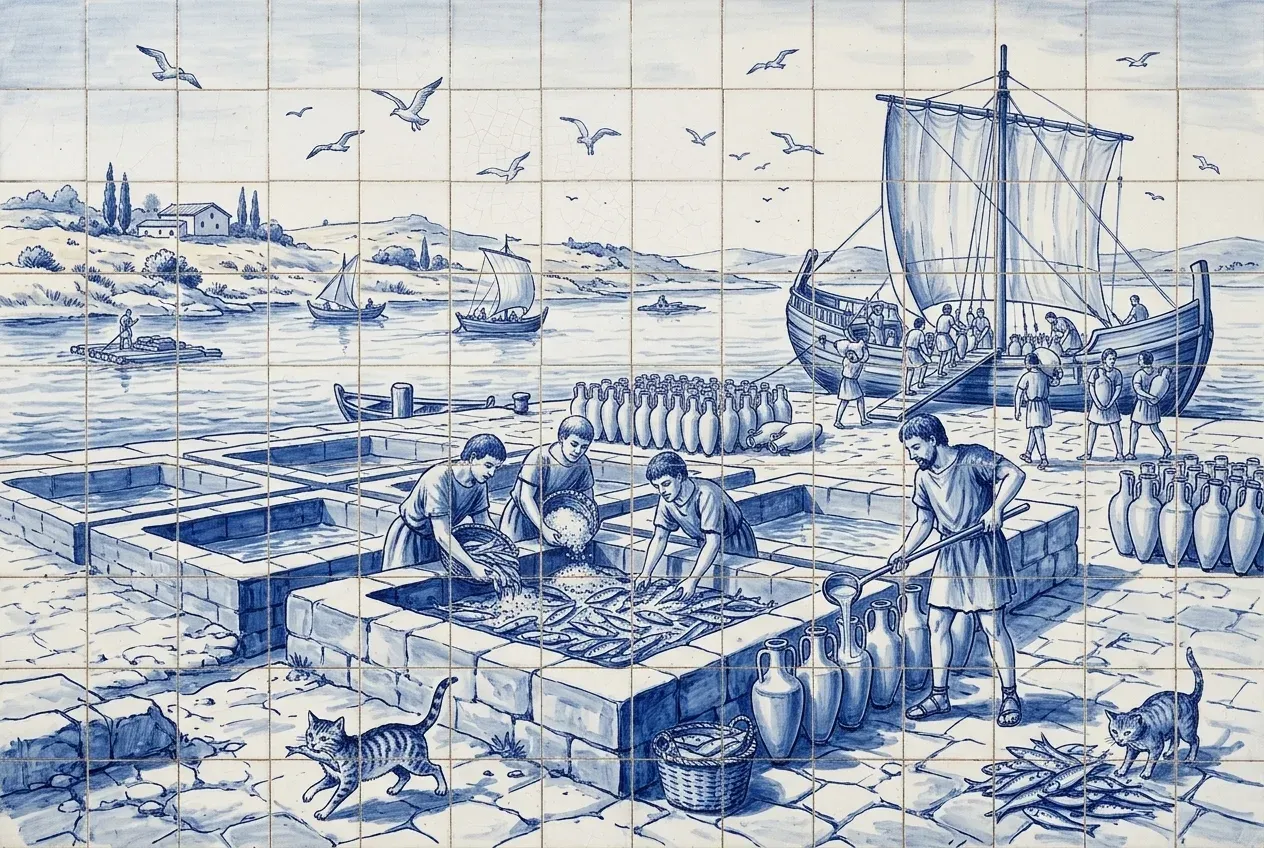
In 1991 a bank in Lisbon’s Lisbon’s “lower town” by the Tagus. After the 1755 earthquake it was rebuilt from scratch on a straight grid of streets.All words → set out to renovate its headquarters. Under the floor, workers found stone vats where the Romans had salted fish. Here on the banks of the Tagus, ancient Olisipo made preserved fish and a pungent sauce of fish, salt, and herbs that was loved across the empire. The bank didn’t fill the find back in, and today a Roman fish factory lies beneath its offices.
More
Context
The sauce was called garum, and for the Romans it was like salt and soy sauce rolled into one. Fish and guts were layered with salt and left to ferment in the sun for weeks, and then the clear liquid was drained off. The best garum was extremely expensive: Pliny the Elder wrote that hardly anything but perfume was valued more.
The A Roman province in the west of the Iberian Peninsula: Portugal south of the Douro and part of today’s Spain. “Lusitanian” often just means Portuguese.All words → coast was one of its main producers. Amphorae of local sauce and fish traveled all over the Mediterranean. In 2021, for the first time in fifteen centuries, garum was made again in a Roman vat: in the ruins of Tróia, across from Setúbal, from local sardines.
In 1995 a museum opened under the bank. Besides the vats, you can see Roman walls, a piece of mosaic floor, and finds from later centuries, right up to the earthquake of 1755.
Where to see it today
Archaeological Center of Rua dos Correeiros (NARC)
Núcleo Arqueológico da Rua dos Correeiros (NARC)
The Roman vats lie right under the bank building, with the entrance around the back.


That was the last story of the era “Lusitania and Rome.” Your panel is complete →