The Bells the King Paid Double For
The bellmakers demanded payment up front. The king paid double.
The story
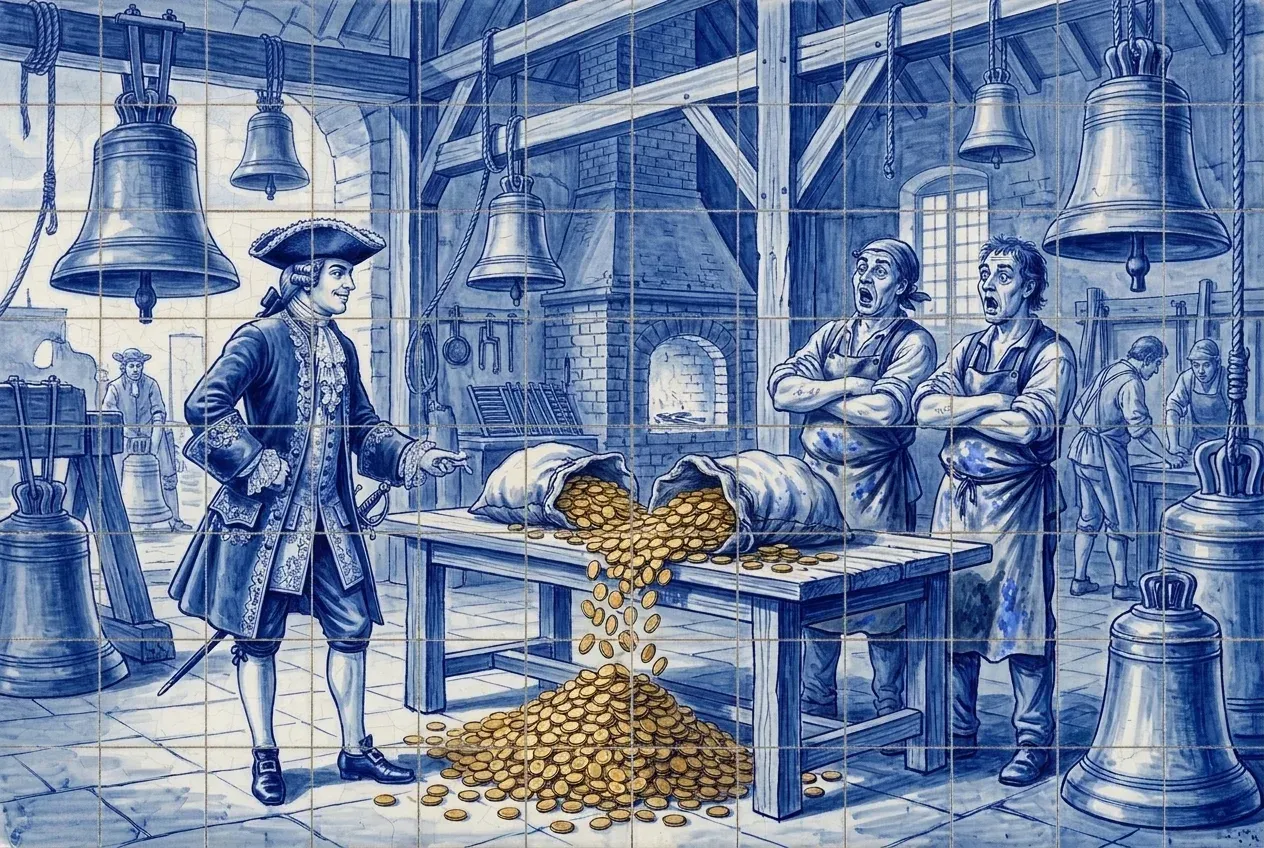
King John V made a vow: if he had a child, he would build a monastery. A daughter was born, and the king kept his word: in 1717 the first stone was laid in Mafra. Gold and diamonds from Brazil poured into the project, and at times 45,000 workers were on site at once. For the two towers, almost a hundred bells were ordered from Flanders, tuned so that melodies could be played on them. The bellmakers doubted Portugal would pay and asked for the money in advance. According to tradition, the king wanted the finest set of bells and answered by doubling the sum.
Meanwhile
- 1726Jonathan Swift publishes Gulliver’s Travels.
More
Context
The bells weren’t just for ringing. They were tuned so that melodies could be played on them, like a giant musical instrument. In Flemish cities, a set of bells like this was the pride of the town hall, and John V wanted Mafra to have the best.
The basilica and monastery were consecrated on October 22, 1730, the king’s 41st birthday, with eight days of celebrations. Work went on until 1755, when the workers were needed in Lisbon after the earthquake.
Mafra cost more than money: over the years, more than 1,300 workers died. In his novel “Baltasar and Blimunda,” José Saramago tells Mafra’s story through the eyes of the people who built it.
Where to see it today
Mafra National Palace
Palácio Nacional de Mafra
The bells hang in the two towers on either side of the basilica’s facade.


Sources (2)· links checked on
- Wikipedia: Palace of Mafra
- Museus e Monumentos de Portugal: Palácio Nacional de Mafra · official page of the monument