
The Rhino and the Elephant
The king pitted a rhino against an elephant. The elephant fled.
The story
In May 1515 a rhinoceros arrived in Lisbon from India, the first live one in Europe since Roman times. On 3 June King Manuel I decided to test Pliny's claim that elephants and rhinos are bitter enemies. A young elephant was brought out before a crowd. It panicked at the noisy crowd and fled before a single blow was struck.
More
Context
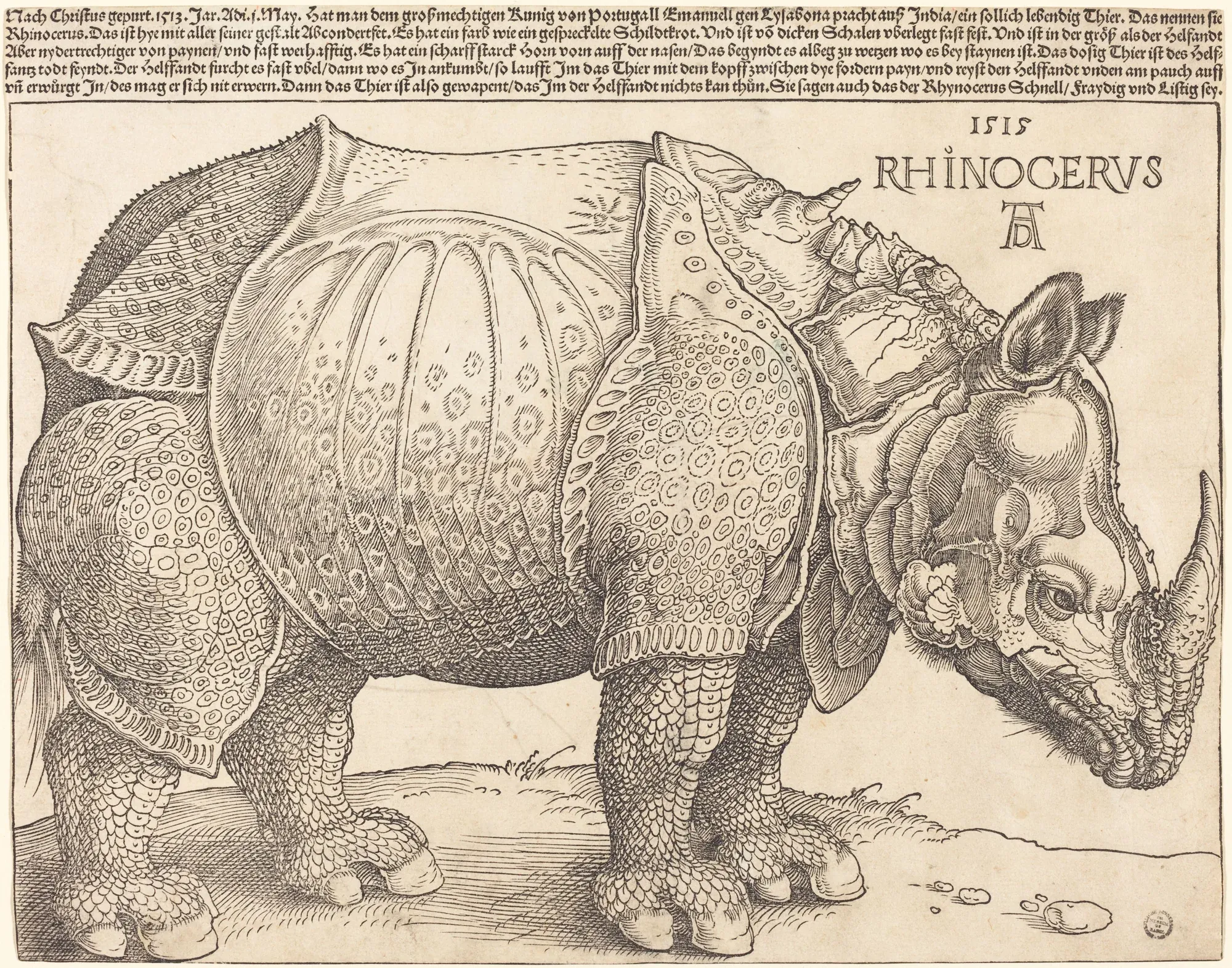
The rhino was a gift from Sultan Muzaffar of Cambay (Gujarat) to the governor Afonso de Albuquerque, who sent it on to Manuel after a four-month voyage. It lived in Europe from 20 May 1515 to January 1516. A year earlier Manuel had sent Pope Leo X an elephant, Hanno, and in December 1515 he decided to send the rhino too. The ship sank in a storm off La Spezia at the end of January 1516, and the animal drowned. Accounts of the body differ: most say it washed ashore and was stuffed and sent on to the Pope, others that the skin went back to Lisbon first. We found no trace of a stuffed rhino today. Albrecht Dürer never saw it: he worked from a sketch and a description from Lisbon, but his woodcut, with its extra horn on the shoulder, became Europe's standard rhinoceros for centuries. In Lisbon, a stone rhinoceros is thought to look out from a corner turret of Belém Tower, built in those same years.

Bridge to today
Belém Tower
Torre de Belém (guarita com o rinoceronte)
On the Tower of Belém, a sentry box carries a carved rhinoceros head.
Av. Brasília, LisboaBridge to today: Belém Tower


Sources (10)· links checked on
- Early depictions of the first Lisbon rhinoceros in the 16th century (Pachyderm, DOI 10.69649/pachyderm.v65i.1312)Accessed on
- University of Warwick, press release on Giorgio Riello's research on Ganda: «How the Pope's rhino drowned»Accessed on
- Google Arts & Culture / DGPC: Bartizan depicting a rhinoceros, Tower of Belém · wording “possibly”Accessed on
- Times Higher Education: «How Leo lionised a jumbo pet» · on Bedini’s book
- International Rhino Foundation: A Gift fit for a King… and Also a Pope!
- L. C. Rookmaaker: Captive rhinoceroses in Europe from 1500 until 1810 (Bijdragen tot de Dierkunde 43, 1973)
- Dorotheum · lot description based on the Albertina data (Vienna)
- British Museum: «Rhinocerus», Albrecht Dürer, 1515 · the date the rhinoceros reached Lisbon, 20 May 1515Accessed on
- Smarthistory: «Dürer’s Rhinoceros: art, science, and the Northern Renaissance»Accessed on
- Silvio A. Bedini, «The Pope’s Elephant», Carcanet, 1997 · a book, no linkAccessed on